How to get more leads from your website in 2026
11 June 2026 · 3 min read
How to get more leads from your website in 2026

Website lead generation is the process of converting anonymous visitors into identifiable prospects through structured conversion paths, targeted content, and visitor intelligence tools. Most UK service businesses already have enough traffic to generate significantly more enquiries. The problem is rarely the volume of visitors. It is what happens after they arrive. By applying proven lead generation techniques, including conversion path optimisation, lead magnets, and visitor identification software, you can increase website leads without rebuilding your site or increasing your ad spend. This article covers exactly how to do that.
How to get more leads from your website: conversion paths first
A conversion path is the sequence of steps a visitor takes from first landing on your site to submitting their contact details. It typically includes a call to action, a landing page, a form, and a thank-you page. Each element either moves the visitor forward or loses them.
The most common failure point is decision clarity. Visitors arrive, scan the page, and cannot immediately understand what you do, who you serve, or what to do next. This is not a design problem. It is a messaging problem. Clarity and trust improve conversion more reliably than visual redesigns, and messaging tests consistently outperform layout changes. That means rewriting your headline and CTA often produces better results than commissioning a new website.

Friction is the second major barrier. Long forms, vague CTAs, and pages that ask visitors to make a large commitment before they have enough information all reduce submission rates. Improving conversion path clarity and reducing friction can increase enquiry completions by 30 to 40 per cent. Moving from a 1 per cent conversion rate to 2.5 per cent on the same traffic volume more than doubles your monthly leads. That is a significant return for a relatively small change.
Common conversion bottlenecks to audit on your site:
- A headline that describes your business rather than the outcome you deliver
- A single generic CTA (“Contact us”) with no specificity about what happens next
- Forms with more than five fields on a first-touch page
- No social proof near the point of conversion (reviews, accreditations, client logos)
- Thank-you pages that confirm submission but do nothing to deepen engagement
Pro Tip: Rewrite your primary CTA to describe the next step, not the outcome. “Get a free quote in 24 hours” outperforms “Get in touch” because it sets an expectation and reduces perceived risk.
For a practical checklist of what a conversion-focused website needs on each page, the principles above apply whether you are a builder, consultant, or local service provider.
Which lead generation techniques work best for UK SMEs?
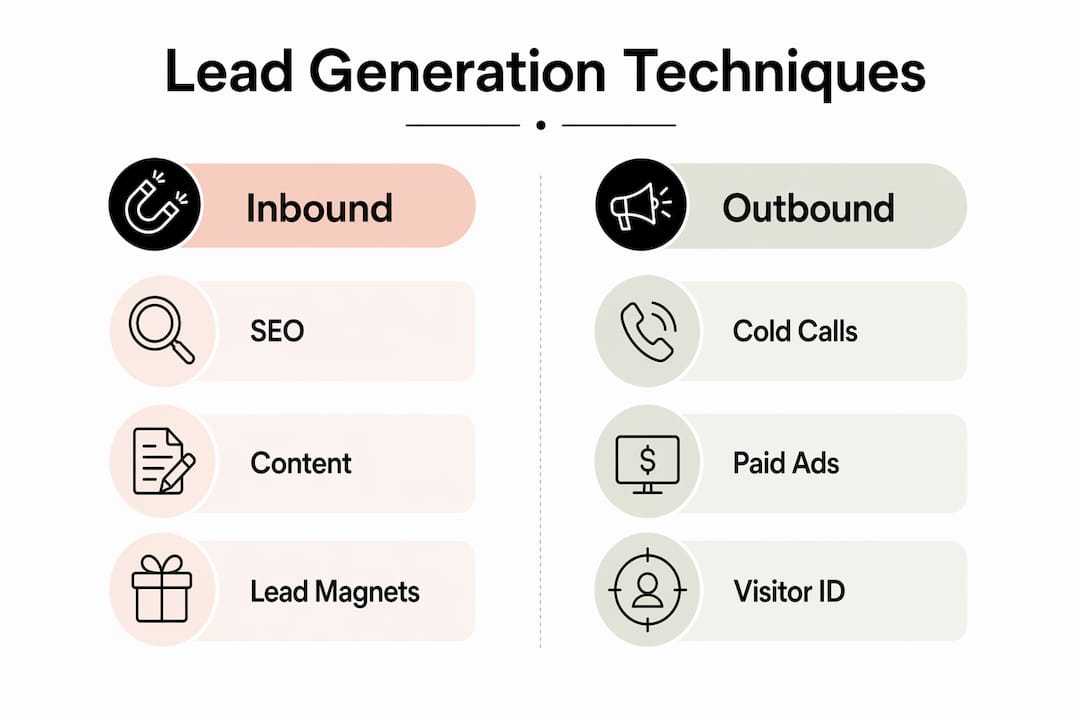
Not all lead generation techniques deliver equal results for service businesses. The table below compares the most practical options for small to medium-sized businesses operating in the UK.
| Technique | Best for | Speed of results | Cost level |
|---|---|---|---|
| SEO and content | Long-term qualified traffic | Slow (3 to 12 months) | Low to medium |
| Lead magnets | Capturing warm visitors | Medium (weeks) | Low |
| Visitor identification | Uncovering anonymous traffic | Fast (days) | Medium |
| Paid search (PPC) | Immediate volume | Fast | High |
| Lead scoring with CRM | Prioritising best prospects | Medium | Medium |
SEO is the highest-quality source of inbound leads over time. SEO-driven leads close at a 14.6 per cent rate compared to just 1.7 per cent for outbound leads. That gap exists because organic visitors are actively searching for what you offer. They arrive with intent, which makes them far easier to convert.
Lead magnets, such as checklists, templates, and short guides, give visitors a reason to share their contact details before they are ready to enquire. They work particularly well on service pages where visitors are researching options but not yet committed. The key is matching the magnet to the page. A visitor reading about loft conversions responds better to a “Loft conversion cost guide” than a generic newsletter sign-up.
Visitor identification software is the most underused tool in the UK SME market. Up to 350 to 400 companies per 1,000 visitors can be identified using tools like Leadinfo or Leadfeeder, compared to roughly 20 leads from forms alone. That is a 20-fold increase in actionable intelligence from the same traffic. Sophisticated B2B firms use visitor identification to uncover anonymous traffic and turn it into warm leads for sales follow-up.
Combining these techniques produces better results than relying on any single approach. Balancing inbound and outbound strategies yields both long-term pipeline growth and near-term revenue. For most UK SMEs, the practical starting point is fixing conversion paths first, then adding lead magnets, then layering in visitor identification as budget allows.
How to implement visitor identification and lead magnets
Deploying these tools does not require a full website rebuild. The steps below apply to most service business websites regardless of platform.
-
Install visitor identification software. Tools such as Leadinfo, Leadfeeder, or Albacross place a tracking script on your site and match visitor IP data against company databases. Set up alerts for companies that visit your pricing or services pages more than once. These are your warmest prospects.
-
Define what data to track. Focus on company name, pages visited, time on site, and visit frequency. A company that visits your case studies page three times in a week is a stronger prospect than one that bounced from your homepage.
-
Create one lead magnet per core service page. The most effective formats for UK service businesses are checklists, cost guides, and short templates. A roofing company might offer a “Roof inspection checklist.” A consultancy might offer a “Project brief template.” Keep the download to one to two pages. Longer content reduces completion rates.
-
Reduce form fields to three or four. Shorter forms reduce friction and increase lead volume. Ask for name, email, and one qualifying question. You can gather more detail during follow-up. For enquiry forms specifically, the advice on forms that get finished is worth reviewing before you make changes.
-
Use a micro-yes before the main ask. A micro-yes is a small commitment step that precedes the contact form. Asking “Would you like a free cost estimate?” before showing the form builds commitment incrementally. Micro-yes steps increase email opt-in rates by reducing the perceived size of the ask.
Pro Tip: Place your lead magnet offer within the body of your service page, not just in the sidebar or footer. Visitors who are reading your content are already engaged. That is the moment to offer them something of value.
How to use SEO and lead scoring to attract better prospects
Attracting more visitors is only useful if those visitors are likely to convert. SEO and lead scoring together address both sides of that equation.
On the SEO side, keyword research tools such as Google Search Console, Ahrefs, or Semrush reveal which search terms are already driving traffic to your site and which high-intent terms you are missing. Prioritise pages that target specific service and location combinations. “Commercial electrician in Leeds” converts better than “electrician” because the intent is clearer and the competition is lower.
Page speed directly affects both SEO rankings and conversion rates. Google uses Core Web Vitals as a ranking signal, and slow pages lose visitors before they read a single line of content. Use Google PageSpeed Insights to identify the three to five changes with the highest impact. Compressing images and removing unused scripts typically produce the fastest gains.
Lead scoring assigns a numerical value to each prospect based on their behaviour and profile. The table below shows a simple scoring model for a B2B service business.
| Signal | Score |
|---|---|
| Visited pricing page | +15 |
| Downloaded a lead magnet | +10 |
| Returned to site more than twice | +10 |
| Company size matches ideal client | +10 |
| Submitted a contact form | +25 |
Combining website behaviour with firmographics enables smarter lead management and helps sales teams focus on prospects most likely to convert. Integrating this scoring into a CRM such as HubSpot or Pipedrive means your team receives a ranked list of prospects each morning rather than a raw list of names. Automating intent signals equips sales teams to prioritise outreach effectively and build timely relationships.
Modern buyers engage through an average of 10 channels, which means your website is one touchpoint in a longer journey. Lead scoring helps you identify where each prospect is in that journey so your follow-up is relevant rather than generic.
What common mistakes reduce website lead generation?
Most lead generation problems are not traffic problems. They are conversion problems that compound over time because they go undiagnosed.
The most damaging mistake is treating traffic growth as a proxy for lead growth. Adding more visitors to a page that converts at 0.5 per cent produces proportionally more wasted spend. Fix the conversion rate first, then scale traffic.
A weak value proposition is the second most common issue. Visitors need to understand within a few seconds what you do, who you serve, and why you are the right choice. Vague headlines like “Welcome to our website” or “Quality services you can trust” communicate nothing specific and give visitors no reason to stay. Understanding where enquiries disappear on your site is the first step to fixing this.
Other frequent mistakes include:
- Asking for too much information on first contact (company registration, budget range, project timeline all in one form)
- No follow-up system for inbound leads, meaning enquiries go cold within hours
- Running no tests on CTAs, headlines, or form layouts, so performance never improves
- Ignoring mobile experience, where a significant proportion of B2B research now takes place
Speed of follow-up is one of the most underrated lead generation factors. A prospect who submits a form and receives a response within five minutes is far more likely to convert than one who waits 48 hours. Automate your initial response if you cannot guarantee a fast manual reply.
Key takeaways
Fixing your conversion path delivers more leads from existing traffic faster than any other single change you can make to your website.
| Point | Details |
|---|---|
| Conversion paths come first | Improving clarity and reducing friction increases enquiry completions by 30 to 40 per cent without extra traffic. |
| SEO delivers the highest-quality leads | Organic leads close at 14.6 per cent versus 1.7 per cent for outbound, making SEO the most cost-effective long-term channel. |
| Visitor identification multiplies intelligence | Tools like Leadinfo reveal up to 400 companies per 1,000 visitors compared to roughly 20 from forms alone. |
| Short forms and micro-yes steps increase volume | Reducing form fields to three or four and using incremental commitment steps raises submission rates measurably. |
| Lead scoring focuses your follow-up | Combining behavioural data with company profile in a CRM ensures your team contacts the right prospects at the right time. |
What I have learned about lead generation for UK service businesses
Working with trades businesses and local service providers across the UK, the pattern I see most often is this: the website looks reasonable, the traffic is decent, but the leads are thin. The instinct is to redesign. The reality is that a redesign rarely solves a messaging problem.
The businesses that see the fastest improvement are the ones that treat their website as a decision system rather than a digital brochure. They ask: what does a visitor need to see, believe, and feel before they will submit a form? Then they build towards that answer, one page at a time.
The counter-intuitive insight is that small changes compound quickly. Rewriting a headline, shortening a form, and adding one piece of social proof near the CTA can move a conversion rate from 1 per cent to 2 per cent within a few weeks. That is not a dramatic transformation. It is a disciplined sequence of small improvements, each one measurable.
I am also sceptical of businesses that focus exclusively on inbound. SEO and content are powerful, but they are slow. Visitor identification gives you a way to act on existing traffic right now, before your SEO investment matures. The combination of both is what produces consistent lead flow rather than feast-and-famine cycles.
The final point I would make is about measurement. You cannot improve what you do not track. Set up Google Analytics 4, connect it to Google Search Console, and monitor your top landing pages weekly. If a page gets traffic but no conversions, that is your next project.
— Ben
How gtwelve helps UK service businesses generate more leads

gtwelve builds conversion-focused websites and lead generation systems for UK trades businesses, local service providers, and SMEs. If your site is getting traffic but not enough enquiries, the issue is almost always fixable without a full rebuild. gtwelve audits your conversion paths, rewrites key pages for clarity, and connects enquiry forms into automated follow-up workflows so no lead goes cold. From website lead generation strategy to CRM integration and SEO, everything is built around one goal: more qualified enquiries from the traffic you already have. Get in touch to find out what is holding your site back.
FAQ
What is the fastest way to get more leads from a website?
Improving your conversion path, specifically your headline, CTA, and form length, produces results faster than any other change. Moving from a 1 per cent to a 2.5 per cent conversion rate on existing traffic more than doubles your monthly leads without additional spend.
How many form fields should a lead capture form have?
Three to four fields is the recommended maximum for a first-touch enquiry form. Reducing form length significantly increases submission rates, with additional qualification handled during follow-up.
What is visitor identification software and is it worth it for SMEs?
Visitor identification tools such as Leadinfo or Leadfeeder match your website traffic against company databases, revealing which businesses are browsing your site. For B2B service providers, this can uncover up to 400 companies per 1,000 visitors compared to roughly 20 from form submissions alone.
Do SEO leads convert better than paid leads?
SEO-driven leads close at a 14.6 per cent rate compared to 1.7 per cent for outbound leads. The difference is intent. Organic visitors are actively searching for your service, which makes them significantly easier to convert than cold outbound contacts.
How quickly should you follow up with a new website lead?
Follow up within five minutes where possible. Prospects who receive a fast response are substantially more likely to convert than those who wait hours or days. Automated acknowledgement emails and CRM alerts help maintain speed even outside business hours.
Recommended
If this sounds like your website, we can take a look.
Note 43 of 72