How pillar pages improve SEO: a 2026 guide
17 July 2026 · 3 min read
How pillar pages improve SEO: a 2026 guide

A pillar page is a central, authoritative content hub that improves SEO by consolidating related topics into one structured page, signalling topical authority to both search engines and AI platforms. Understanding how pillar pages improve SEO is no longer optional for content marketers. Google officially recognised topical authority as a ranking factor in 2023, and its December 2025 core update doubled down on content depth. Sites that have adopted the pillar and cluster model are already pulling ahead. The evidence is clear, and the structure is replicable.
What SEO benefits do pillar pages actually deliver?
Pillar pages produce measurable gains across every core SEO metric. Sites implementing pillar page strategies see 30–50% increases in organic traffic within 6–12 months, even without acquiring new backlinks. That uplift comes from improved topical authority and a stronger internal link structure, not from chasing domain metrics.
The ranking improvements are equally significant. Websites using pillar pages are 50% more likely to rank in the top 10 results and attract 25% more backlinks than sites without a cluster structure. The same data shows a 40% increase in time on site and a 20% higher conversion rate. Those figures matter because they confirm that pillar content does not just attract visitors. It keeps them engaged and moves them toward action.

AI search engines add another dimension to the pillar pages SEO benefits picture. Content clusters with pillar pages receive 3.2 times more AI search engine citations and a 63% increase in keyword rankings within 90 days. That is a significant competitive advantage as AI-powered search results become the default experience for many users.
The impact of pillar content also extends to backlink acquisition. A well-structured pillar page gives other sites a single, authoritative destination to reference. Scattered, unconnected articles rarely earn that kind of editorial trust.
Key SEO gains from a pillar page strategy at a glance:
- 30–50% organic traffic increase within 6–12 months
- 50% higher likelihood of ranking in the top 10
- 25% more backlinks compared to unstructured content
- 3.2× more AI search engine citations for clustered content
- 40% more time on site and 20% higher conversion rates
How should you structure a pillar page and content cluster?
The hub-and-spoke model defines the architecture of an effective SEO content structure. The pillar page is the hub. It covers a broad topic at a high level, providing enough depth to establish authority without exhausting every subtopic. Cluster articles are the spokes. Each one covers a specific subtopic in full detail and links back to the pillar.
A pillar page should cover broad topic scope while cluster articles provide focused, in-depth coverage to avoid keyword cannibalisation. Overlap in coverage causes ranking conflicts and dilutes authority. The rule is simple: the pillar introduces, the cluster article goes deep.
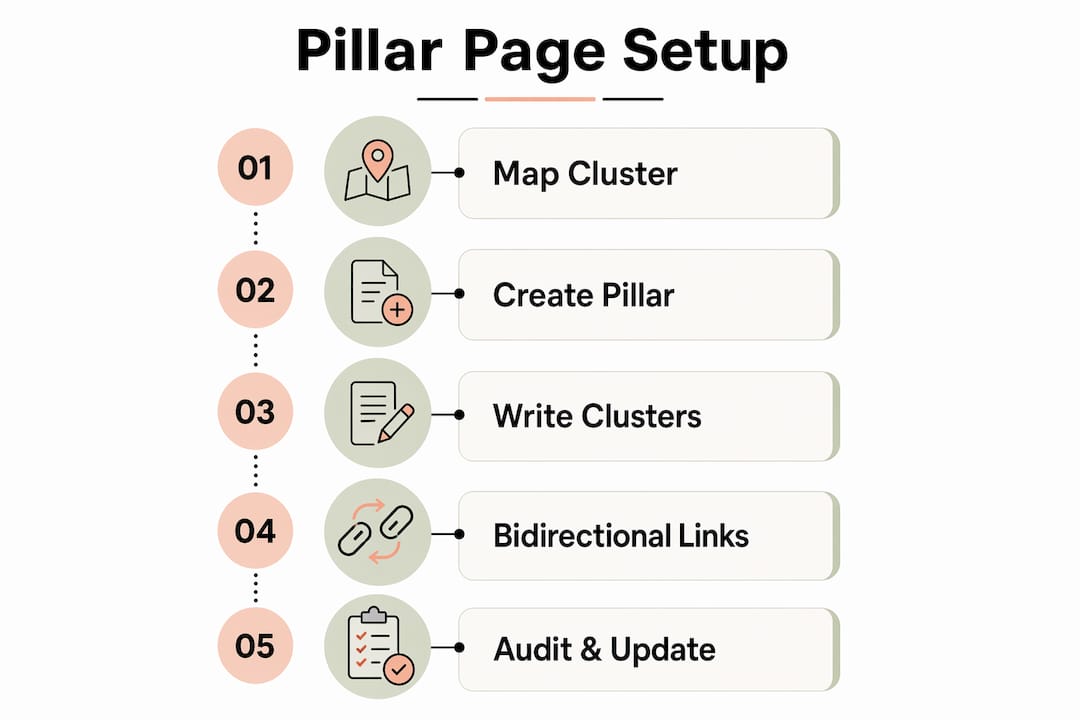
Bidirectional linking is non-negotiable
Internal links must use purposeful, descriptive anchor text with consistent bidirectional linking to pass authority effectively. Without return linking from cluster articles back to the pillar, those articles remain isolated. They weaken the authority signal rather than reinforcing it. Every cluster article must link to the pillar, and the pillar must link to every cluster article.
Descriptive anchor text matters here. Linking with “click here” or “read more” wastes the authority signal. Linking with “local SEO for tradespeople” or “content cluster planning” tells Google exactly what the destination page covers. That specificity strengthens the topical map Google builds for your site.
Map your cluster before you write the pillar
A successful pillar and cluster ecosystem requires mapping subtopics beforehand and aligning content strictly by coverage breadth and depth. Writing the pillar first and inventing cluster topics later leads to overlap, gaps, and wasted effort. Start with a full list of subtopics. Assign each one to either the pillar (brief coverage) or a cluster article (full coverage). Then write.
Pro Tip: Publish your pillar page and at least 3–5 cluster articles within the same 2–4 week window. Clusters live within 2–4 weeks of pillar publication send a strong topical authority signal to Google and accelerate ranking gains.
| Pillar page | Cluster article |
|---|---|
| Broad topic overview | Single subtopic in full depth |
| Links out to all cluster articles | Links back to the pillar page |
| Targets head keyword | Targets long-tail or specific keyword |
| Updated regularly to stay current | Updated when the subtopic changes |
A well-planned URL structure for your pillar and cluster pages also reinforces the hierarchy. Clean, descriptive URLs help search engines understand the relationship between pages before they even read the content.
What mistakes limit pillar page SEO performance?
Most pillar pages fail due to lack of supporting cluster content and insufficient internal linking. A pillar page without cluster articles is just a long article. It has no ecosystem to draw authority from and no structure to signal topical depth. Publishing a pillar in isolation is the single most common and most damaging mistake.
The second most common failure is keyword cannibalisation. This happens when the pillar page and a cluster article both target the same subtopic at the same depth. Google cannot determine which page to rank, so it ranks neither well. The fix is strict content mapping before writing begins.
Common pillar page mistakes and how to fix them:
- Orphaned pillar pages. No cluster content exists to support the hub. Fix: plan and publish 3–5 cluster articles within 4 weeks of the pillar.
- Keyword cannibalisation. Pillar and cluster articles target identical subtopics. Fix: assign each subtopic exclusively to one page.
- Weak internal linking. Cluster articles do not link back to the pillar. Fix: add bidirectional links with descriptive anchor text to every article.
- Neglecting updates. The pillar page becomes outdated while cluster articles evolve. Fix: schedule a quarterly content audit for the pillar.
- Unstable URLs. Changing the pillar URL after publication breaks inbound links and AI citations. Fix: finalise the URL before publishing and never change it.
Pro Tip: Run a content audit every quarter. Check that every cluster article still links to the pillar, that anchor text remains descriptive, and that the pillar accurately reflects the current state of each subtopic it references.
How do pillar pages boost visibility in AI-powered search?
AI search engines do not rank pages the way traditional algorithms do. They cite sources. Pillar pages act as citation moats for AI search engines, requiring dense, well-sourced factual content and URL stability during updates. A citation moat is the position your pillar page occupies when AI models consistently pull from it as the authoritative source on a topic. Losing that position is easy if you change your URL or let content go stale.
Linking out to authoritative external sources increases the likelihood of AI search engines citing your pillar page. Co-citation patterns show that outbound authoritative links correlate with inbound AI citations. This is counterintuitive for many content marketers who fear sending visitors away. The data says the opposite: linking out builds credibility, and credibility drives citations.
Practical steps for optimising your pillar page for AI citation:
- Prioritise claim density. State facts clearly and early. AI models extract definitive claims, not vague commentary.
- Cite authoritative sources. Link to recognised industry bodies, peer-reviewed research, and established publications.
- Keep URLs stable. Never change a pillar page URL after publication. Stable URL structures during content refreshes preserve AI citation surfaces and prevent authority erosion.
- Refresh content regularly. Update facts, statistics, and examples without restructuring the page or changing the URL.
- Structure for extraction. Use clear headings, short paragraphs, and direct answers. AI models favour content that is easy to parse.
For a deeper look at how this applies to your site, the gtwelve guide on AI-powered search in 2026 covers the technical and content requirements in detail.
| AI citation factor | Why it matters |
|---|---|
| Claim density | AI models extract and cite definitive factual statements |
| Outbound authority links | Co-citation patterns increase inbound AI citation likelihood |
| URL stability | Changing URLs breaks existing citation surfaces |
| Regular content refresh | Keeps the page current without disrupting citation anchors |
| Clear heading structure | Helps AI models identify and extract specific answers |
Key takeaways
Pillar pages improve SEO by creating a structured content hub that signals topical authority, attracts backlinks, and positions your site as the definitive source for AI-powered search citations.
| Point | Details |
|---|---|
| Traffic and ranking gains | Pillar strategies drive 30–50% more organic traffic and a 50% higher chance of top-10 rankings. |
| AI citation advantage | Clustered content receives 3.2× more AI search citations, making pillar pages critical for 2026 visibility. |
| Bidirectional linking | Every cluster article must link to the pillar, and the pillar must link back, using descriptive anchor text. |
| Avoid cannibalisation | Assign each subtopic exclusively to either the pillar or a cluster article, never both at equal depth. |
| URL stability | Never change a pillar page URL after publication. Stable URLs preserve AI citation surfaces and authority. |
Why pillar pages reward patience more than most SEO tactics
The most underrated aspect of pillar page strategy is how long it takes to see the full return. Most content marketers expect results within weeks. The reality is that the 30–50% traffic gains documented in the research typically materialise over 6–12 months. That timeline frustrates teams under pressure to show quick wins, and it causes many to abandon the strategy before it compounds.
What I have found working with service businesses is that the planning phase is where most value is either created or destroyed. Teams that map their cluster topics carefully, assign coverage depth deliberately, and publish with discipline consistently outperform those who write the pillar first and figure out the cluster later. The architecture matters more than the word count.
The other thing I would push back on is the idea that a pillar page is a one-time project. The sites that hold their citation position in AI search are the ones treating their pillar pages like living documents. They refresh statistics, add new cluster links as articles are published, and check internal linking quarterly. That discipline is unglamorous, but it is what separates a pillar page that compounds in authority from one that peaks and fades.
If you are working on service area pages as part of a local SEO strategy, the same cluster logic applies. Each location or service can function as a cluster article feeding authority back to a central pillar. The model scales.
— Ben
How gtwelve can help you build a pillar page strategy
Content marketers and SEO professionals who understand the theory often find that execution is where progress stalls. Mapping clusters, planning internal links, maintaining refresh discipline, and aligning content with business goals all take time and coordination.

gtwelve works with UK service businesses to design and implement content strategies built around pillar pages and topic clusters. From initial cluster mapping through to technical SEO, internal linking audits, and AI search visibility, gtwelve brings the full picture together. If you want a content structure that compounds over time rather than one that plateaus, see how gtwelve approaches SEO for service businesses and get in touch to discuss your site.
FAQ
What is a pillar page in SEO?
A pillar page is a central content hub that covers a broad topic at a high level and links to cluster articles that explore each subtopic in depth. It signals topical authority to search engines and AI platforms.
How long does it take for pillar pages to improve SEO?
Sites typically see 30–50% increases in organic traffic within 6–12 months of implementing a pillar and cluster strategy. Ranking improvements can appear within 90 days when cluster articles are published promptly.
How many cluster articles does a pillar page need?
Publishing at least 3–5 cluster articles within 2–4 weeks of the pillar page sends a strong topical authority signal to Google. More cluster articles strengthen the signal further, provided each covers a distinct subtopic.
What is keyword cannibalisation in a pillar page strategy?
Keyword cannibalisation occurs when the pillar page and a cluster article both target the same subtopic at the same depth. This causes ranking conflicts and dilutes authority. Strict content mapping before writing prevents it.
Why do pillar pages matter for AI search engines?
AI search engines cite authoritative, well-structured content hubs rather than ranking pages in the traditional sense. Pillar pages with stable URLs, dense factual claims, and outbound links to authoritative sources are cited 3.2 times more frequently than unstructured content.
Recommended
If this sounds like your website, we can take a look.
Note 07 of 72