Why portfolio pages win customers: a 2026 guide
29 June 2026 · 3 min read
Why portfolio pages win customers: a 2026 guide

A portfolio page is a curated, conversion-focused presentation of your work, built to generate business enquiries rather than simply display past projects. This distinction matters enormously. Clients decide within 3 seconds whether a portfolio demonstrates the problem-solving capability they need. That window is too short for a gallery. It demands a sales asset. Understanding why portfolio pages win customers starts with accepting that your portfolio is not a record of what you have done. It is a tool for winning what comes next.
Why portfolio pages win customers: the conversion logic
Portfolio pages function as conversion funnels, not archives. Their job is to take a visitor with a specific problem and move them towards making an enquiry. That requires two things working together: proof of capability and a clear path to contact.
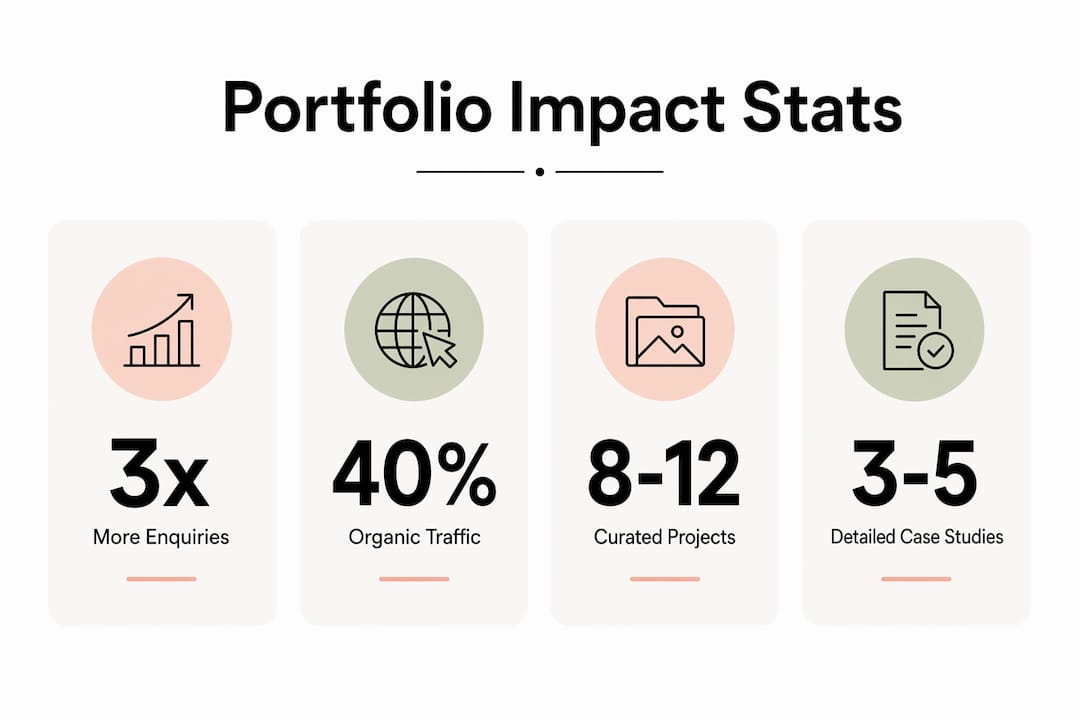
Portfolios with integrated contact forms and clear calls-to-action generate three times more leads than those relying on a standard email link. The reason is friction. An email link forces the visitor to open a mail client, compose a message, and wait. A contact form keeps them on your site and captures their details immediately. That difference in friction is the difference between a lead and a lost visitor.
The structural elements that make a portfolio convert are specific. You need:
- Curated projects: 8–12 examples, selected for relevance to your target clients, not volume
- Case studies: 3–5 detailed write-ups showing the problem, your approach, and the measurable outcome
- Integrated contact form: placed prominently, with no more than four fields
- Clear calls-to-action: one per page, directing visitors to a single next step
- Social proof: client testimonials positioned near the call-to-action, not buried at the bottom
Portfolios with 3–5 strong case studies generate more engagement than those with 15 or more listings. Overloaded profiles see a 40% drop in engagement. That figure tells you something important: more work does not mean more trust. Selectivity signals confidence.
Pro Tip: Add a budget band field to your contact form. Visitors who select a budget range are self-qualifying. This filters out low-value enquiries before they reach your inbox and saves time on discovery calls that go nowhere.

The benefits of portfolio pages extend beyond aesthetics. When structured correctly, they reduce the sales cycle by answering the client’s core question before the first conversation even begins.
Does showing measurable outcomes actually win more clients?
The answer is yes, and the reason is straightforward. Clients come to your portfolio with a task in mind. They are not evaluating your taste. They are assessing whether you can solve their problem and deliver a result worth paying for.
Most portfolios fail this test. They function as trophy cases, displaying finished work without explaining what the work achieved. A portfolio designed as a sales asset that demonstrates business outcomes justifies premium pricing far more effectively than an aesthetic-only gallery. The difference is not design quality. It is framing.
Consider the contrast between two ways of describing the same project:
| Description style | Example |
|---|---|
| Generic framing | “Redesigned the website for a retail client.” |
| Outcome-based framing | “Redesigned checkout flow for a UK retailer, reducing cart abandonment by 22% in 90 days.” |
The outcome-based version answers the client’s real question: what will I get? It also gives you a defensible reason to charge more.
“Portfolios showing proof with real metrics outperform polished but slow-loading sites. In the era of skills-based hiring, evidence beats presentation.”
Handling confidential work is a common concern. NDA-restricted projects do not have to disappear from your portfolio entirely. Describing a project by its sector and outcome scope retains professional credibility without breaching confidentiality. “Improved lead conversion for a mid-sized B2B software firm” communicates capability without naming the client. That approach keeps your portfolio relevant and your obligations intact.
The metrics that resonate most with prospective clients are conversion rates, revenue impact, time saved, and user engagement increases. If you do not have those figures, describe the problem clearly and explain your process. Clarity about your thinking is the next best thing to a hard number.
How do SEO and site speed affect portfolio performance?
A portfolio that no one finds cannot win customers. Technical quality determines whether your work reaches the right people in the first place.
Structured portfolio sites using schema.org markup gain 40% more organic traffic year-over-year than unstructured equivalents. Schema markup tells search engines exactly what your page contains, which improves how your results appear in search and increases click-through rates. Adding schema to your portfolio pages is a one-time technical task with compounding returns.
Site speed matters just as much. A slow-loading portfolio loses visitors before they see a single project. Mobile responsiveness is not optional. The majority of initial site visits now happen on mobile devices, and a portfolio that breaks on a phone signals carelessness before you have said anything about your work. The gtwelve approach to website design and trust treats speed and mobile performance as baseline requirements, not enhancements.
Keyword alignment in your case studies also drives organic traffic. Write project descriptions using the language your prospective clients actually search for. A landscaper’s portfolio case study titled “Garden redesign for a semi-detached property in Surrey” will attract more relevant traffic than “Project 14: Residential.” Specificity serves both the reader and the search engine.
Pro Tip: Publish a short blog post for each major case study. Link the post to the portfolio entry. This creates two indexed pages per project, doubles your search footprint, and gives you content to share on LinkedIn without repeating yourself.
Regularly updated content signals to search engines that your site is active. A portfolio last updated in 2023 tells Google and prospective clients the same thing: this business may not be current.
How often should you update your portfolio to keep winning leads?
Portfolio maintenance is not a one-off task. It is a recurring discipline that directly affects how many enquiries you receive.
Professionals who update their portfolios quarterly report 50% more profile views and twice as many inbound contacts. That uplift comes from fresh content signalling activity, improved search indexing, and the compounding effect of new case studies reaching new audiences.
A practical maintenance routine looks like this:
- Quarterly case study review: Add one new outcome-based case study every three months. Remove any project that no longer reflects your current positioning or target client.
- Monthly analytics check: Track enquiry form submissions, bounce rate on portfolio pages, and time on page. A high bounce rate on a specific project page usually means the framing is weak, not the work.
- Testimonial collection: After each completed project, ask the client for a short written statement. Aim for one new testimonial per quarter. Place it near your call-to-action, not in a separate testimonials section that visitors rarely reach.
- Niche alignment audit: Every six months, review whether your portfolio still reflects the clients you want to attract. If you have moved into a new sector, your portfolio should show that shift, not your history.
- Response time discipline: Respond to every portfolio enquiry within two hours during business hours. Speed of response is itself a signal of professionalism. Clients who enquire through a portfolio are already warm. A slow reply cools them quickly.
The lead generation impact of a well-maintained portfolio compounds over time. Each new case study adds a searchable page. Each testimonial adds credibility. Each analytics review removes a weak point. The portfolio that wins the most clients is not the most beautiful one. It is the one that is most consistently maintained.
Key takeaways
Portfolio pages win customers when they function as conversion tools, not galleries, combining curated proof with clear enquiry pathways and regular updates.
| Point | Details |
|---|---|
| Conversion structure matters | Integrated contact forms generate three times more leads than email links alone. |
| Fewer, stronger projects win | Portfolios with 3–5 case studies outperform those with 15 or more listings. |
| Outcomes beat aesthetics | Framing work around measurable results justifies premium pricing and builds client trust. |
| Technical SEO drives visibility | Schema.org markup increases organic traffic by 40% year-over-year for structured portfolio sites. |
| Quarterly updates compound returns | Regular portfolio refreshes produce 50% more profile views and twice the inbound contact rate. |
Portfolios are sales tools, not scrapbooks
The most common mistake I see business owners make is treating their portfolio as a record of effort rather than a tool for winning work. They add every project they have ever completed, arrange them chronologically, and wait. The enquiries do not come.
What actually works is ruthless selectivity. Pick the eight to twelve projects that best represent the clients you want more of. Write each one as a case study with a clear problem, a clear process, and a clear result. Then put a contact form at the end of every page and respond to every submission the same day.
I have seen businesses transform their enquiry rate not by redesigning their site, but simply by rewriting three case studies with outcome data and moving the contact form above the fold. The work did not change. The framing did.
The other thing I would push back on is the idea that a portfolio needs to be visually spectacular to win clients. Clarity beats spectacle every time. A client who can quickly understand what you do, who you do it for, and what result they can expect will enquire. A client who spends three minutes trying to decode a beautifully animated homepage will leave.
Portfolios are evolving into the primary trust signal in the digital marketing funnel. They are increasingly the first and sometimes only thing a prospective client reviews before making contact. Treat yours accordingly.
— Ben
How gtwelve builds portfolio pages that generate enquiries
gtwelve designs conversion-focused websites for UK service businesses, with portfolio pages built to attract the right clients and capture their details efficiently.

Every portfolio gtwelve builds includes integrated contact forms with budget filtering, outcome-focused case study layouts, schema markup for search visibility, and mobile-first performance. The result is a portfolio that works as a lead generation tool, not just a showcase. If your current portfolio is not producing consistent enquiries, talk to gtwelve about what a conversion-focused rebuild looks like for your business.
FAQ
Why do portfolio pages convert better than service pages alone?
Portfolio pages show proof of delivery rather than promises of capability. Clients make faster decisions when they can see real outcomes from comparable projects.
How many projects should a portfolio include?
8–12 curated projects with 3–5 detailed case studies is the optimal range. Portfolios with more than 15 listings see a 40% drop in engagement.
Can I include NDA-restricted work in my portfolio?
Yes. Describe the client’s sector and the outcome scope without naming the client. This retains relevance and professional credibility without breaching confidentiality.
How does schema markup help a portfolio page?
Schema.org markup tells search engines what your page contains, improving how results appear in search. Structured portfolio sites gain 40% more organic traffic year-over-year than unstructured equivalents.
How quickly should I respond to portfolio enquiries?
Respond within two hours during business hours. Prospective clients who enquire through a portfolio are already engaged. A slow response reduces the likelihood they will proceed.
Recommended
If this sounds like your website, we can take a look.
Note 25 of 72