What is a testimonial page and why it matters
9 July 2026 · 3 min read
What is a testimonial page and why it matters

A testimonial page is a dedicated section of your website that collects and displays verified customer feedback to build trust and influence purchasing decisions. Unlike scattered quotes on a homepage, a testimonial page functions as a social proof hub where prospective clients can validate their decision to buy. Businesses that use them well see measurable results: featuring testimonials can increase sales by up to 270%, and adding positive reviews to sales pages can boost conversion rates by 34%. For any UK service business looking to attract better enquiries and build credibility online, a well-constructed testimonial page is one of the highest-return pages on your site.
What is a testimonial page and how does it work?
A testimonial page is defined as a curated collection of customer reviews, case studies, and endorsements presented on a single, dedicated webpage. The industry term for this type of page is a “social proof page,” though “testimonial page” is the phrase most businesses and clients use in practice. Both terms describe the same function: giving prospective customers a place to read real experiences before committing to a purchase.
The page works by addressing doubt. When a visitor reaches the evaluation stage of their buying journey, they are not looking for more features. They are looking for reassurance. A testimonial page answers the question every buyer asks privately: “Has this worked for someone like me?” That is why testimonial pages serve as a trust library designed specifically for the final decision-making stage, where visitors validate their purchase justification.

The purpose of testimonial pages goes beyond simply displaying praise. A well-structured page filters objections, demonstrates results, and shortens the sales cycle. It does the persuasion work that a sales call or brochure cannot do alone.
How do testimonial pages influence buying decisions?
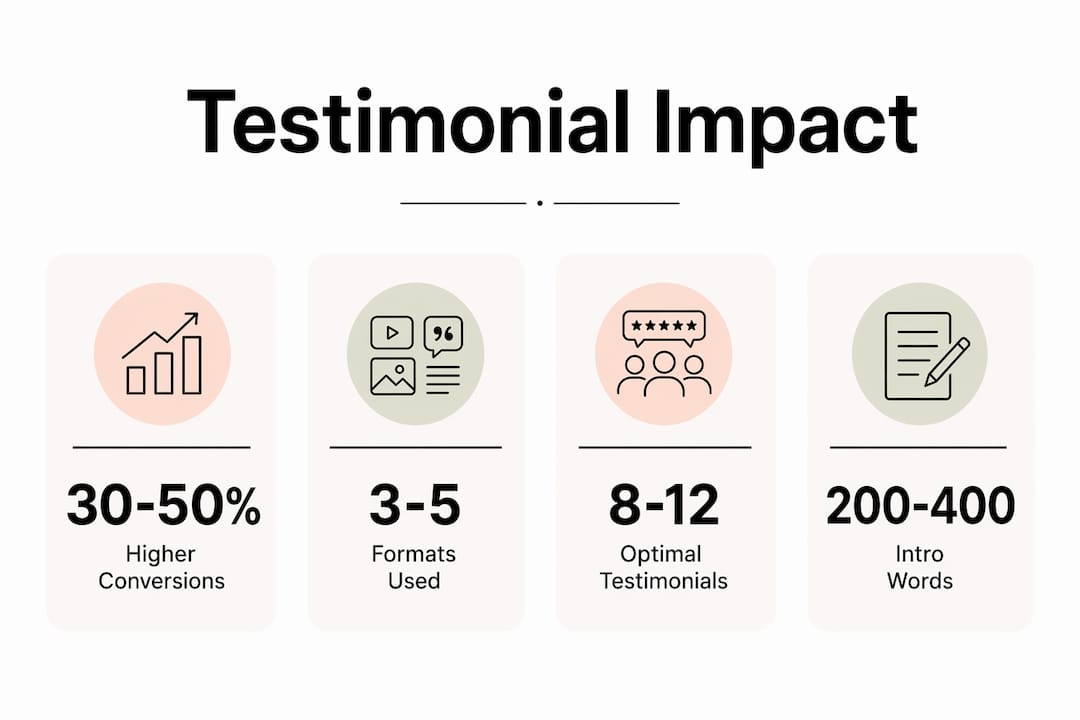
Prospective clients who visit a dedicated testimonial page show a 30–50% higher conversion rate compared to those who do not. That figure reflects a simple truth: reading about someone else’s positive experience removes the risk from a decision. It is the digital equivalent of asking a trusted colleague for a recommendation.
The psychological mechanism is social proof, a concept established in consumer behaviour research. People look to the actions and opinions of others when they are uncertain. A testimonial page concentrates that influence in one place, making it far more effective than a single quote buried in a footer. The importance of customer testimonials lies in their ability to handle objections without a salesperson needing to be present.
Testimonial pages also perform a specific role in the buyer journey. At the awareness stage, a prospect finds you through search or referral. At the consideration stage, they compare options. At the evaluation stage, they need confirmation. A testimonial page is built for that final stage. It is where the decision is made or lost. Businesses that improve website conversion rates consistently point to testimonial pages as one of the most direct levers available.
What should be on a testimonial page?
The benefits of testimonial pages only materialise when the page contains the right elements. A page full of vague, generic quotes does little to convert. The components below define what separates a high-performing testimonial page from a decorative one.
- Full attribution. Every testimonial needs a customer name, photograph, job title, company name, and date. Full attribution builds credibility because it signals that the feedback is real and verifiable. Anonymous quotes carry almost no weight.
- Varied formats. Modern testimonial pages blend text, video, case studies, and social media embeds to match different visitor behaviours. A visitor who skims will read a short quote. A visitor who researches deeply will watch a two-minute video or read a case study.
- Filtering and categorisation. Successful testimonial pages filter by industry, role, or use case, so a visitor from the construction sector can find feedback from a similar business. Relevance drives trust far more than volume.
- Clear calls to action. Place a CTA after every three to five testimonials, not just at the bottom of the page. A visitor who is convinced halfway through should not have to scroll to act.
- SEO-optimised introduction. Adding 200–400 words of keyword-rich copy at the top of the page helps search engines classify and rank the page correctly. This is one of the most overlooked elements in testimonial page design.
Pro Tip: Write the introductory copy on your testimonial page as if you are explaining your service to a new visitor. Use the language your clients use, not your internal terminology. This naturally incorporates the search terms your prospects type.
What mistakes make testimonial pages ineffective?
The most common mistake is treating a testimonial page as a static archive. Businesses collect a handful of quotes at launch, publish them, and never return to the page. A dynamic, continuously updated testimonial page outperforms a static one because it signals an active, growing business. Visitors notice when every testimonial is from three years ago.
A second mistake is publishing generic praise. Quotes like “Great service, highly recommend!” tell a prospective client nothing specific. High-converting testimonial pages focus on measurable outcomes, such as “We reduced our quote turnaround from five days to one day.” That specificity addresses real buyer hesitations.
Other pitfalls to avoid:
- Incomplete attribution. A first name and no photo reads as potentially fabricated. Always include a full name, photo, and company.
- No navigation link. If your testimonial page is not in your main navigation, most visitors will never find it. Treat it as a primary page, not a hidden asset.
- Ignoring mobile layout. A page that looks strong on desktop but breaks on mobile loses the majority of visitors before they read a single review.
- Mixing irrelevant testimonials. A testimonial from a completely different sector can confuse rather than reassure. Relevance matters more than quantity.
Pro Tip: When asking clients for a testimonial, give them a simple prompt: “What specific result did you see, and what would you tell a similar business considering working with us?” This produces outcome-focused feedback rather than vague praise.
How to create a testimonial page that keeps working
Building a testimonial page that continues to generate results requires a repeatable process, not a one-time effort. The steps below apply whether you are starting from scratch or improving an existing page.
- Collect testimonials systematically. Send a short feedback request within 48 hours of completing a project, when the result is fresh. Use a simple form with two or three guided questions rather than an open text box.
- Organise by relevance. Group testimonials by service type, industry, or outcome. A trades business might separate testimonials by service: boiler installation, bathroom fitting, electrical work. This structure helps visitors find proof that matches their situation.
- Add multimedia progressively. Start with text testimonials and attribution photos. Add video testimonials as you collect them. Commission one or two written case studies per year for your most significant projects. This builds depth over time without requiring a large upfront investment.
- Test your layout regularly. Run A/B tests on CTA placement, testimonial order, and page structure every quarter. Small layout changes can produce meaningful shifts in conversion. Portfolio pages and testimonial pages often benefit from the same layout testing discipline.
- Integrate the page into your sales process. Send the link to prospects during the proposal stage. Reference it in follow-up emails. A testimonial page is not just a website asset. It is a sales tool that works between conversations.
- Update the SEO copy annually. Revisit the introductory copy each year to reflect new services, updated language, and current search terms. Companies that actively engage with customer reviews report 35% higher revenue than those that do not. Keeping the page current is part of that engagement.
Key takeaways
A testimonial page is one of the most direct tools a service business has for converting website visitors into paying clients.
| Point | Details |
|---|---|
| Core definition | A testimonial page is a dedicated webpage collecting verified customer feedback to build trust and drive decisions. |
| Conversion impact | Visitors who view a testimonial page convert at a 30–50% higher rate than those who do not. |
| Full attribution matters | Every testimonial needs a name, photo, title, company, and date to be credible and persuasive. |
| Dynamic beats static | Regularly updated pages with varied formats outperform static archives of old quotes. |
| SEO copy is non-negotiable | Adding 200–400 words of keyword-rich introduction helps search engines rank the page and brings in qualified traffic. |
Why most testimonial pages underperform, and what I have learned
The businesses I work with most often have testimonials. What they rarely have is a testimonial page that functions as a deliberate sales asset. The feedback exists in emails, in Google reviews, in WhatsApp messages from happy clients. But it sits scattered and invisible, doing no work at all.
The shift that makes the biggest difference is treating the page as a living document rather than a finished product. I have seen businesses add three specific, outcome-focused testimonials to a well-structured page and watch their enquiry rate change within weeks. Not because the testimonials were extraordinary, but because they were specific, attributed, and placed where a decision-maker would actually read them.
The other lesson I keep returning to is that relevance beats volume. A page with eight highly relevant testimonials from similar clients will outperform a page with forty generic ones. Visitors are not counting. They are scanning for someone who looks like them. Website design affects trust at every level, and a testimonial page that feels curated and current signals a business that takes its reputation seriously.
— Ben
How gtwelve can help you build a testimonial page that converts
A testimonial page is only as effective as the website it sits on. If your site lacks structure, loads slowly, or fails to guide visitors toward a decision, even the strongest testimonials will not convert.

gtwelve builds conversion-focused websites for UK service businesses, with testimonial pages designed to work as active sales tools rather than decorative additions. From layout and attribution structure to SEO copy and CTA placement, every element is built with enquiry generation in mind. If you are ready to turn your client feedback into a page that actually performs, see how gtwelve works and get in touch to discuss your requirements.
FAQ
What is the purpose of a testimonial page?
A testimonial page gives prospective clients a single place to read verified customer feedback before making a purchase decision. It functions as a trust-building asset at the final stage of the buyer journey.
How many testimonials should a testimonial page have?
Quality and relevance matter more than quantity. A page with eight to twelve specific, well-attributed testimonials covering different services or outcomes will outperform a page with dozens of generic quotes.
What formats work best on a testimonial page?
Text testimonials with full attribution form the foundation, but adding video testimonials, case studies, and social media embeds increases persuasiveness for visitors who research in depth before buying.
Does a testimonial page help with SEO?
Yes. Adding 200–400 words of keyword-rich introductory copy helps search engines classify and rank the page, bringing in qualified organic traffic from prospects actively searching for your services.
How often should you update a testimonial page?
Add new testimonials at least quarterly and revisit the page’s introductory copy annually. A page that shows recent feedback signals an active, credible business to both visitors and search engines.
Recommended
If this sounds like your website, we can take a look.
Note 15 of 72