A/B testing websites: a practical guide for 2026
13 June 2026 · 3 min read
A/B testing websites: a practical guide for 2026

A/B testing for websites is defined as a controlled experiment that shows two randomised versions of a page to real visitors, then measures which version performs better on a specific metric such as conversion rate or form completions. Tools like VWO, Optimizely, and HubSpot make this process accessible to marketers and website owners without requiring a data science team. The method removes guesswork by replacing intuition with real user behaviour, making it one of the most reliable ways to improve a site’s performance. Understanding what split testing involves, and how to do it correctly, is the difference between design decisions that work and ones that merely look good.
What is A/B testing on websites?
A/B testing websites is the practice of showing visitors randomised versions of a page to find which performs better on a given metric. Version A is the control, your existing page. Version B is the variant, the page with one deliberate change. Visitors are randomly assigned to each version, and their behaviour is tracked until the test reaches statistical significance.
The core purpose is to isolate cause and effect. If you change a headline and conversions rise, you need confidence that the headline caused the lift, not a seasonal traffic shift or a coincidental change in visitor intent. That confidence comes from random assignment, a pre-defined success metric, and a sufficient sample size. Without these three elements, you are not running a test. You are running a guess with extra steps.

Platforms like Optimizely and VWO handle the traffic splitting and data collection automatically. HubSpot includes A/B testing within its CMS and marketing tools, making it straightforward for service businesses to test landing pages and email sign-up forms. Understanding conversion rate metrics is a useful starting point before you begin, so you know exactly what you are trying to move.
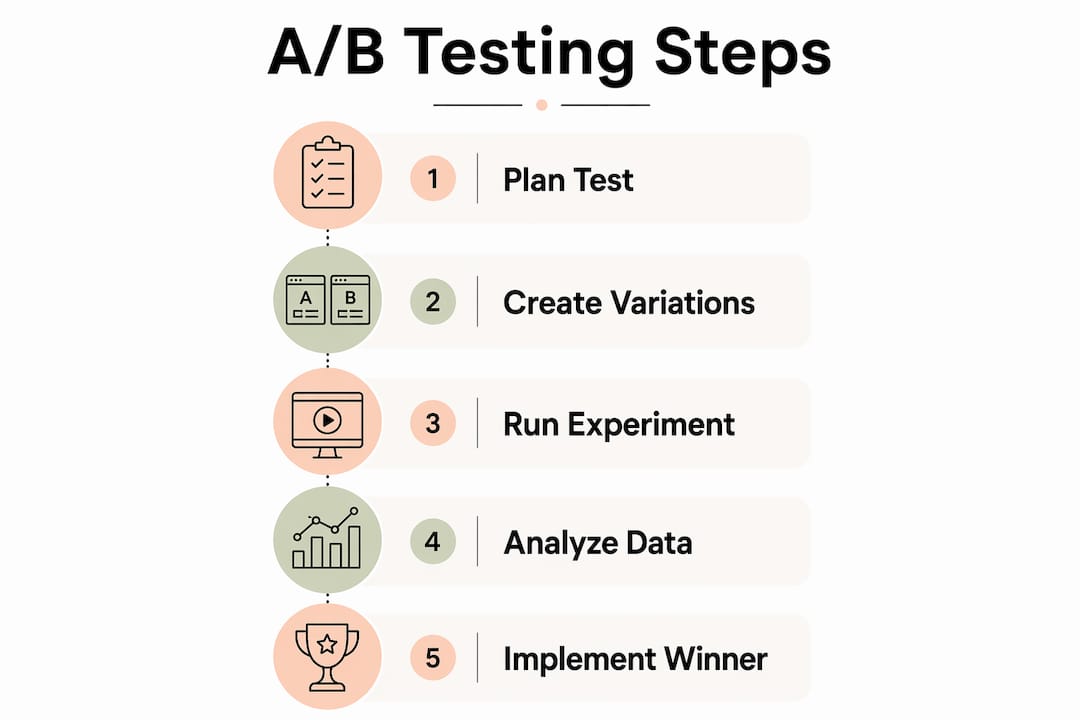
How does A/B testing work on websites?
The methodology follows a structured sequence. Getting this sequence right is what separates reliable results from misleading ones.
-
Define your hypothesis. State clearly what you are changing, why you expect it to improve performance, and what metric you will use to judge success. “Changing the CTA button from grey to green will increase click-through rate because it creates stronger visual contrast” is a testable hypothesis. “Let’s try a different button” is not.
-
Calculate your required sample size. Before launching, use a sample size calculator to determine how many visitors each variant needs. This depends on your baseline conversion rate, the minimum lift you want to detect, your confidence level (typically 95%), and your statistical power (typically 80%). Baseline conversion rate and minimum detectable effect must both be defined before testing begins.
-
Split traffic randomly. Your testing platform assigns visitors to Version A or Version B at random, in real time. Both groups should be exposed simultaneously to eliminate time-based variables such as day-of-week effects or promotional campaigns.
-
Run the test to completion. Typical A/B tests run for one to two weeks to capture enough traffic and account for day-to-day variability. Low-traffic sites may need longer. The runtime should be driven by your sample size calculation, not by impatience.
-
Analyse and act. Once the pre-determined sample size is reached, compare results. If the variant outperforms the control at your confidence threshold, implement the change. If not, document what you learned and form a new hypothesis.
Pro Tip: Always run tests for at least one full business week, even if your sample size is reached sooner. Visitor behaviour on Mondays differs from Fridays, and cutting a test short on a Wednesday can skew your results significantly.
What website elements are commonly A/B tested?
Testing elements such as headlines, CTAs, layout, navigation, and form design are the most common starting points for conversion optimisation. Each element influences user behaviour in a different way, and small changes can produce meaningful results.
- Headlines. The headline is often the first thing a visitor reads. Testing different value propositions, lengths, or tones can reveal what resonates with your audience.
- Call-to-action buttons. Button colour, copy, size, and placement all affect click-through rates. Facebook, LinkedIn, and Instagram have all optimised engagement through interface variations, including button-level changes.
- Form design. Reducing the number of fields, changing labels, or reordering questions can increase form completions. This is particularly relevant for service businesses focused on lead generation.
- Page layout. Moving a testimonial block above the fold, or placing a pricing summary next to a CTA, can change how visitors process information and decide to act.
- Images and visual content. Testing a photo of a real person against a product shot, or a video against a static image, can reveal which format builds trust faster.
Not every test needs to be a simple A/B comparison. Here is a quick reference for choosing the right test type:
| Test type | What it tests | When to use it |
|---|---|---|
| A/B test | One variable, two versions | Most situations; clear, reliable attribution |
| Multivariate test | Multiple variables simultaneously | High-traffic sites needing to test combinations |
| Split URL test | Two entirely different page designs | Major redesigns or new page concepts |
| A/A test | Identical versions | Validating your testing tool’s accuracy |
Multivariate testing requires significantly more traffic than a standard A/B test to reach significance across all variable combinations. For most UK service businesses and SMEs, a straightforward A/B test on one element at a time is the most practical and reliable approach.
What are the statistical pitfalls in website A/B testing?
Statistical errors are the most common reason A/B test results mislead rather than inform. Understanding the two key controls helps you avoid the most costly mistakes.
Statistical confidence (typically set at 95%) controls the rate of false positives. It tells you the probability that a detected difference is real and not due to random chance. Statistical power (typically set at 80%) controls the rate of false negatives. It tells you the probability that your test will detect a real difference if one exists. Understanding both is crucial for interpreting results correctly. A test with low power may show no significant difference simply because it lacked the sample size to detect one.
The most damaging mistake in practice is peeking. Stopping tests early when results appear significant inflates false-positive rates well beyond the planned 5%. If you check your results daily and stop the moment Version B looks like a winner, you are likely acting on noise rather than signal. Many teams have rolled out changes based on peeked results, only to see conversions return to baseline within weeks.
- Many teams underestimate required traffic for small lift detection, leading to under-powered tests and unreliable conclusions.
- Running overlapping tests on the same pages corrupts both tests by introducing confounding variables.
- Segmenting results by device, location, or traffic source after the fact (without pre-planning) increases the chance of finding spurious patterns.
Pro Tip: Set your sample size, confidence level, and power before the test launches. Write them down. Treat them as fixed. Changing the goalposts mid-test is the single fastest way to generate results you cannot trust.
How does SEO A/B testing differ from standard testing?
SEO A/B testing measures the impact of on-page changes on organic search performance, rather than on direct user conversions. The methodology shares the same principles as standard split testing, but introduces one critical constraint: search engines must see the same content as users.
SEO A/B testing requires serving consistent content to both users and search engine crawlers. If Googlebot sees Version A while users see Version B, that is cloaking, a practice that violates Google’s guidelines and can result in ranking penalties. This rules out most client-side JavaScript implementations for SEO tests, since crawlers may not execute JavaScript reliably.
The recommended approach follows these steps:
- Use server-side or template-based implementations, where the variant is served at the server level before the page reaches the browser.
- Apply changes to a group of similar pages rather than a single URL, using one set as the control and another as the variant. This is sometimes called a split-page or grouped test.
- Measure organic impressions, clicks, and rankings over a sufficient period, typically four to eight weeks, to account for crawl frequency and index lag.
- Avoid using canonical tags or noindex directives to hide variant pages from search engines, as this prevents valid measurement of ranking impacts.
Server-side or template-based methods are preferred because they deliver the same HTML to both users and crawlers, keeping the test valid and the site compliant. For service businesses investing in technical SEO and content strategy, SEO A/B testing is a powerful way to validate on-page changes before rolling them out site-wide.
Key takeaways
A/B testing websites produces reliable results only when tests are pre-planned with defined sample sizes, run to completion without peeking, and isolate a single variable per experiment.
| Point | Details |
|---|---|
| Define before you test | Set your hypothesis, metric, sample size, and confidence level before launching any test. |
| One variable at a time | Isolating a single change per test is what makes attribution reliable and results actionable. |
| Avoid peeking | Stopping a test early when results look promising inflates false positives and leads to bad decisions. |
| SEO tests need server-side delivery | Serving different content to crawlers and users risks cloaking penalties; use template-based implementations. |
| Statistical power matters | A test with insufficient traffic may miss a real improvement; calculate required sample size upfront. |
Why most A/B testing programmes fail before they start
I have seen the same pattern repeat across service businesses that attempt A/B testing for the first time. They pick a test, launch it, check the dashboard after three days, see Version B winning by 12%, and call it done. Two months later, conversions are back where they started, and the team concludes that A/B testing does not work for their site.
The test was not the problem. The process was. Running a valid test requires discipline that feels counterintuitive when you are used to moving fast. You have to commit to a sample size before you see any data. You have to resist checking results until the test is complete. You have to accept that most tests will show no significant difference, and that this is useful information, not a failure.
The businesses I have seen get genuine value from split testing share one habit: they treat each test as a learning exercise, not a conversion fix. They document every hypothesis, every result, and every follow-up question. Over time, that catalogue of tests becomes a genuine competitive asset. It tells you what your specific audience responds to, in a way that no industry benchmark ever can.
If you are starting out, focus on high-traffic pages with clear conversion goals. A contact page, a service landing page, or a quote request form are all good candidates. Keep your first tests simple. One headline change. One button colour. One form layout. Build the habit of completing tests properly before you attempt anything more complex.
— Ben
How gtwelve can support your conversion optimisation

gtwelve builds conversion-focused websites for UK service businesses, trades, and SMEs, with a structure designed to support ongoing testing and improvement from day one. Every site we build is set up to track enquiries and conversions properly, so you have the baseline data you need before any test begins. If you want to move beyond guesswork and start making design decisions backed by real visitor behaviour, talk to gtwelve about how we approach website performance for service businesses.
FAQ
What is A/B testing on a website?
A/B testing on a website is a controlled experiment where two versions of a page are shown to visitors at random to determine which performs better on a specific metric, such as conversion rate or form completions.
How long should a website A/B test run?
Most A/B tests should run for one to two weeks to capture sufficient traffic and account for day-to-day variability. The actual duration should be driven by a pre-calculated sample size, not a fixed time period.
What is the difference between A/B testing and split testing?
A/B testing and split testing refer to the same methodology. Split testing sometimes describes tests comparing two entirely different page URLs, while A/B testing more commonly refers to on-page element changes, but the terms are used interchangeably across most platforms.
Can A/B testing harm your SEO?
A/B testing can harm SEO if variant pages serve different content to search engine crawlers than to users, which constitutes cloaking. Using server-side or template-based implementations avoids this risk and keeps tests compliant with Google’s guidelines.
How many visitors do you need for a valid A/B test?
The required number of visitors depends on your baseline conversion rate, the minimum improvement you want to detect, your confidence level, and your statistical power. There is no universal number. Use a sample size calculator before launching any test.
Recommended
If this sounds like your website, we can take a look.
Note 41 of 72