UX design for business: what it means and why it matters
26 June 2026 · 3 min read
UX design for business: what it means and why it matters

UX design in business is defined as the practice of shaping every interaction a customer has with your service, online or offline, so that it meets their needs while advancing your commercial goals. The industry term is user experience design, often shortened to UX design. For service sector businesses, this is not a luxury reserved for tech companies. It is the difference between a website that converts visitors into paying clients and one that sends them to a competitor. Every dollar invested in UX returns an estimated $100, representing a 9,900% return on investment. That figure alone should reframe how you think about your website, your booking process, and every digital touchpoint your customers encounter.
What is UX design in business and why does it matter?
UX design for businesses is the process of researching how customers behave, identifying where they struggle, and then redesigning those experiences to remove friction. It covers everything from how quickly your website loads to how clearly your service pages explain what you offer. The goal is always the same: make it easier for the right person to take the right action.

The importance of UX in business becomes clear when you look at the cost of getting it wrong. 88% of users will not return to a website after a single bad experience. That is not a recoverable situation for most small service businesses. One poor interaction, whether a confusing contact form or a slow page, can permanently remove a potential client from your pipeline.
UX design is not the same as having a good-looking website. It is a research-driven discipline that uses data, customer feedback, and structured testing to make decisions. Tools like Google Analytics, Hotjar, and A/B testing platforms give businesses measurable evidence of what is and is not working. The result is a website and service process built around how your customers actually think, not how you assume they do.
How does UX design impact business performance and profitability?
The business case for UX is grounded in measurable outcomes. Conversion rates can increase by 200–400% through well-executed UX improvements. For a service business generating 20 enquiries a month, that kind of uplift is transformational.
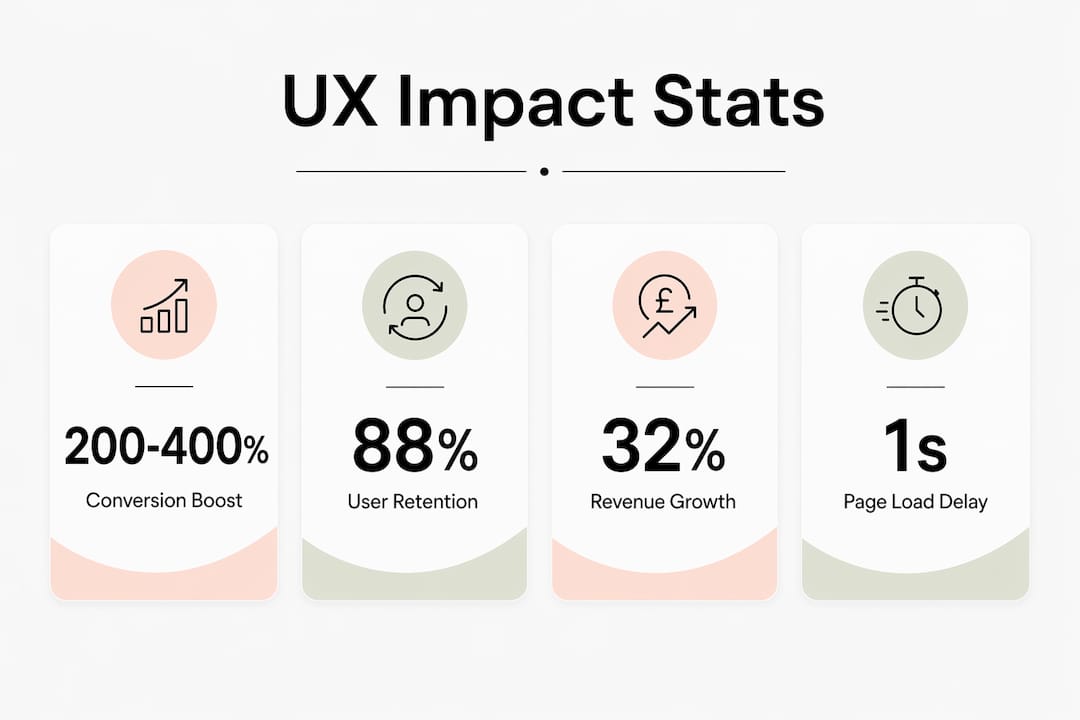
Page speed is one of the most overlooked UX factors in the service sector. A one-second delay in page load reduces conversion rates by 20% and customer satisfaction by 16%. Slow websites do not just frustrate visitors. They actively cost you revenue every single day they remain unaddressed.
Customer willingness to pay is also directly linked to experience quality. 86% of buyers are willing to pay more for a superior customer experience. This means investing in UX is not just about getting more enquiries. It is about attracting clients who value quality and are prepared to pay for it.
The practical areas where UX improvements deliver the clearest returns for service businesses include:
- Page load speed: Slow pages increase bounce rates and reduce enquiry volume directly.
- Contact and quote forms: Complicated or lengthy forms are abandoned before completion. Frictionless quote form design is one of the fastest wins available.
- Mobile experience: Most service enquiries now originate from mobile devices. A desktop-only design approach loses a significant share of potential clients.
- Clear calls to action: Visitors need to know exactly what to do next. Vague or buried calls to action reduce conversion rates measurably.
Pro Tip: Run your website through Google PageSpeed Insights today. If your mobile score is below 70, page speed is likely costing you enquiries right now.
What are the key principles of an effective UX strategy?
A successful UX strategy aligns user needs with business goals across four core areas: business strategy, value innovation, validated user research, and frictionless UX. Each one is necessary. Skipping any of them produces a website that looks good but does not perform.
Here is how each principle applies to a service business:
-
Business strategy alignment. Your UX decisions must connect directly to your commercial objectives. If your goal is to increase quote requests by 30%, every design choice on your website should be evaluated against that target. An effective UX strategy requires understanding your business vision first, then designing around it.
-
Value innovation. This means identifying what your customers genuinely value and making that the centrepiece of their experience. For a trades business, that might be instant online quoting. For a consultancy, it might be a clear explanation of the process before any commitment is required.
-
Validated user research. Assumptions about what customers want are expensive. Real research, including interviews, session recordings, and usability tests, replaces guesswork with evidence. This does not require a large budget or a specialist team.
-
Frictionless UX. Every unnecessary step between a visitor arriving and them making an enquiry is a point of potential drop-off. Frictionless design removes those steps. It means shorter forms, clearer navigation, and faster pages.
| UX strategy component | Business outcome |
|---|---|
| Business strategy alignment | UX investment targets measurable commercial goals |
| Value innovation | Customers find what they need quickly, reducing drop-off |
| Validated user research | Design decisions are based on evidence, not assumption |
| Frictionless UX | Fewer barriers between visitor and enquiry |
Pro Tip: Before redesigning anything, spend one hour watching session recordings in Hotjar or Microsoft Clarity. You will see exactly where visitors stop and leave.
How does UX design differ from visual or UI design?
UX design and UI design are related but distinct disciplines. UI, or user interface design, focuses on the visual appearance of a product: colours, typography, button styles, and layout. UX design focuses on the entire experience a customer has, including the parts that have nothing to do with visuals.
A website can be visually impressive and still perform poorly. If the navigation is confusing, the booking process has too many steps, or the page takes four seconds to load, the visual design becomes irrelevant. UX is a research-driven discipline that relies on metrics like bounce rates, session duration, and support ticket volume to identify problems, not on aesthetic judgement.
“Business leaders should rely on metrics like bounce rates and support tickets to assess UX value, not on how the website looks to them personally.”
For business owners in the service sector, this distinction matters practically. You can spend money on a new visual identity and see no improvement in enquiries if the underlying experience remains broken. The impact of website design on trust is real, but trust is built through clarity and reliability, not decoration.
What a UX designer actually does in a business context includes:
- Conducting customer interviews and analysing behaviour data
- Mapping the full customer journey from first visit to completed enquiry
- Building prototypes and running usability tests before committing to a design
- Tracking performance metrics after launch and iterating based on results
- Aligning design decisions with conversion rate targets and business goals
How can service businesses implement UX design principles practically?
Implementing UX improvements does not require a full agency retainer or a six-month project. Service businesses can make meaningful progress with a structured approach applied incrementally. UX improvements throughout the product lifecycle lead to significant gains in retention and revenue over time, making it an ongoing process rather than a one-off project.
Follow these steps to begin:
-
Define your UX goal in business terms. Decide what you want to improve and by how much. “More enquiries” is not specific enough. “Increase quote form completions by 25% in 90 days” gives you something to measure.
-
Audit your current performance. Use website performance tracking tools to establish your baseline. Record your current bounce rate, average session duration, and conversion rate before making any changes.
-
Run usability tests with a small group. Testing with only 5 to 8 real users uncovers the vast majority of critical UX issues. Ask five people who match your typical client profile to complete a task on your website, such as requesting a quote, while you observe. The problems they encounter will be consistent and actionable.
-
Fix the highest-impact issues first. Page load speed, mobile usability, and form completion rates typically deliver the fastest returns. Address these before moving to more complex changes.
-
Test changes before committing. A/B testing tools like Google Optimize or VWO let you run two versions of a page simultaneously and measure which performs better. This removes opinion from the process entirely.
-
Track, review, and repeat. UX improvement is not a project with an end date. Review your conversion rate metrics monthly and treat every data point as an instruction for the next iteration.
Pro Tip: Ask your last five clients how they found your website and what nearly stopped them from making an enquiry. Their answers will identify your biggest UX problems faster than any tool.
Key takeaways
UX design in business is a measurable, research-driven discipline that directly determines how many visitors become paying clients, making it one of the highest-return investments a service business can make.
| Point | Details |
|---|---|
| UX drives measurable revenue | Conversion rates can increase by 200–400% through well-executed UX improvements. |
| Poor UX has a direct cost | A one-second page load delay reduces conversion rates by 20% and satisfaction by 16%. |
| Strategy must come before design | Align UX decisions with specific business goals before changing anything visual. |
| Small-scale testing works | Testing with 5 to 8 users uncovers the majority of critical UX issues affordably. |
| UX is an ongoing investment | Incremental improvements across the customer journey compound into significant retention gains. |
Why UX deserves a seat at the business table
Companies with strong design maturity report 32% higher revenue growth and 56% higher returns to shareholders. I have seen this play out repeatedly with service businesses that treated their website as a brochure rather than a sales tool. The moment they started making decisions based on user behaviour data rather than personal preference, their enquiry volumes shifted.
The most common mistake I see is business owners conflating UX with aesthetics. They invest in a new logo or a redesigned homepage and expect results. When the enquiries do not increase, they conclude that digital marketing does not work for their sector. The real issue is almost always structural. The experience is broken at the point of conversion, not at the point of attraction.
UX design is evolving from a visual role into a strategic, research-driven discipline that affects whether a business survives and grows. The businesses that treat it as such, integrating it early into how they plan their services and digital presence, consistently outperform those that treat it as an afterthought. The data is not ambiguous on this point.
If I had one piece of advice for a service business owner reading this, it would be to spend one hour this week watching how real people use your website. Not reading analytics reports. Watching. The gap between what you think your customers experience and what they actually experience is almost always larger than you expect.
— Ben
How gtwelve supports service businesses with UX and digital performance
gtwelve works with UK service businesses to build websites that are designed around how customers actually behave, not how business owners assume they do.

Every website gtwelve builds is conversion-focused from the ground up. That means fast load times, clear service pages, frictionless enquiry forms, and performance tracking built in from day one. If your current website is generating traffic but not enquiries, the problem is almost certainly a UX issue that can be identified and fixed. Visit gtwelve.co.uk to see how we approach website design, SEO, and workflow automation for service businesses across the UK.
FAQ
What is UX design in a business context?
UX design in business is the practice of shaping customer interactions with your service, particularly online, so they are easy, clear, and effective. The goal is to align the customer experience with your commercial objectives, such as generating more enquiries or reducing drop-off.
How does UX design affect conversion rates?
Well-executed UX improvements can increase conversion rates by 200–400%. Removing friction from key steps, such as contact forms and page load times, has the most direct impact on enquiry volume.
Is UX design only relevant for large businesses?
UX design is relevant for any business with a website or digital customer touchpoint. Small service businesses often see the fastest returns because their starting point has the most room for improvement.
What is the difference between UX and UI design?
UI design covers the visual appearance of a website or product. UX design covers the entire customer experience, including behaviour, navigation, speed, and the ease of completing a task. A website can have strong UI and poor UX.
How much does it cost to improve UX for a service business?
Basic UX improvements, such as fixing page speed, simplifying forms, and running usability tests with five to eight users, can be done at low cost. The return on even modest UX investment is well documented, with Forrester’s research citing a $100 return for every $1 spent.
Recommended
If this sounds like your website, we can take a look.
Note 28 of 72