Website redesign explained for business owners
16 June 2026 · 3 min read
Website redesign explained for business owners

A website redesign is defined as a ground-up reconstruction of your site’s design, structure, and technology to improve user experience, branding, and business performance. This is not a cosmetic update or a few new images. It is a full strategic overhaul covering information architecture, visual identity, technical foundations, and content. Tools like Figma for design and Webflow or WordPress for development are standard in the process. SEO migration, including 301 redirects and metadata transfer, is a critical component that many businesses overlook. Understanding what is website redesign explained properly means recognising it as a marketing system, not a one-off project. Businesses see up to 30% sales increases following a comprehensive redesign. That figure alone justifies treating the process with the seriousness it deserves.
What does the website redesign process involve?
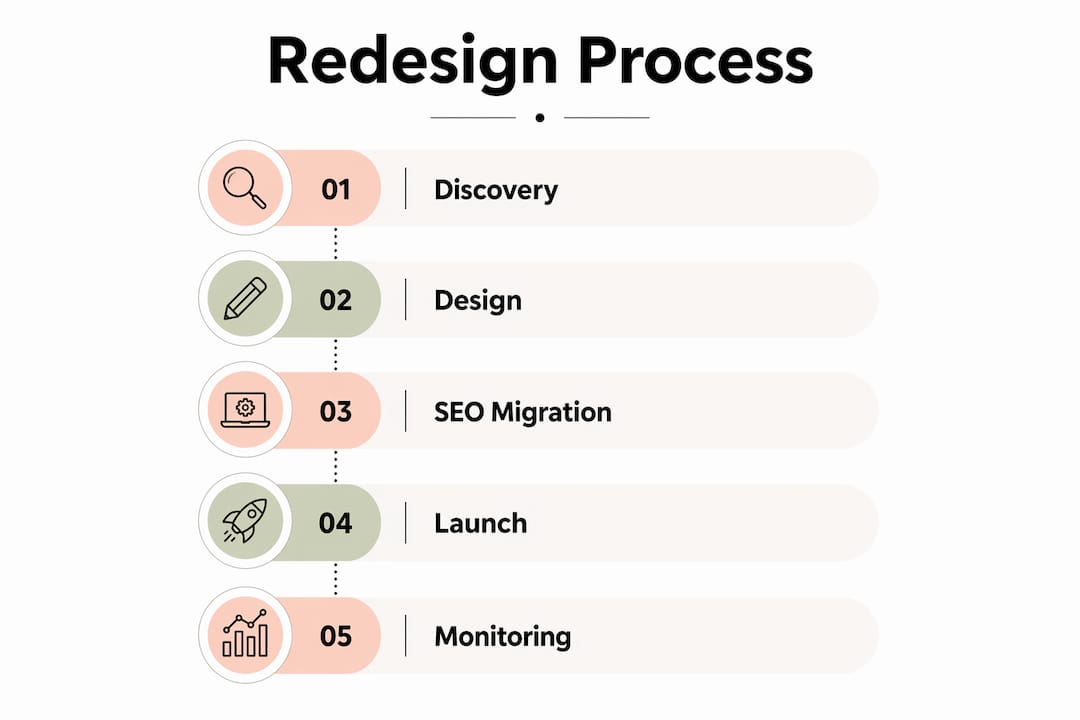
The website redesign process follows a structured sequence of phases, each with defined deliverables and timelines. Skipping or compressing any phase increases the risk of costly rework and poor results.
Phase 1: Strategic Discovery (Weeks 1–4)
The discovery phase defines your business objectives, target user needs, and measurable success metrics. Success in redesign is largely determined here, before a single wireframe is drawn. Stakeholders agree on goals, competitors are audited, and the site’s current performance is benchmarked. Tangible deliverables like sitemaps and content plans emerge from this phase.
Phase 2: Design and Development (Weeks 4–10)

Wireframes and visual mockups are created in tools like Figma, then approved before development begins. A typical redesign follows a 12-week timeline, with design and development running in parallel where possible. Building in Webflow, WordPress, or a custom CMS happens during this window. Content is written and structured alongside design, not after it.
Phase 3: SEO Migration
SEO migration is the phase most businesses underestimate. Failing to preserve metadata or implement 301 redirects causes permanent search ranking loss. Every URL that changes needs a redirect. Metadata, page titles, and structured data must transfer to the new site before launch.
Phase 4: Launch and Post-Launch Monitoring (90 Days)
At launch, DNS propagation takes 24–48 hours, during which traffic fluctuations are normal. The 90 days after launch are critical for monitoring KPIs such as bounce rate, conversion rate, and organic traffic. Iterative improvements during this window protect and build on the investment made.
Pro Tip: Treat your redesign launch as the beginning of a cycle, not the end of a project. Sites that receive structured post-launch attention consistently outperform those that are left static after going live.
What are the key benefits of a website redesign?
A well-executed redesign delivers measurable improvements across multiple areas of business performance. The benefits are not cosmetic. They affect revenue, search visibility, and customer trust directly.
- Higher conversion rates. Improved user experience through intuitive navigation and appealing visual design increases visitor retention and the likelihood of enquiry or purchase.
- Better search rankings. SEO improvements such as faster page load speeds, cleaner content structure, and proper heading hierarchy boost organic search visibility. More organic traffic means more qualified leads without additional ad spend.
- Stronger brand credibility. A dated website signals a dated business. A modern, professional design builds immediate trust with prospective clients, particularly in competitive service sectors.
- Mobile experience gains. Good mobile UX can increase returning visitor rates by up to 74%. For trades and local service businesses, where a large proportion of traffic arrives via mobile search, this is a direct revenue driver. You can read more about this in gtwelve’s guide on mobile UX for trades.
- Sales growth. Businesses that complete a comprehensive redesign see up to 30% sales increases. That figure reflects the combined effect of better UX, stronger SEO, and clearer conversion pathways working together.
The benefits compound over time when the site is treated as a living system rather than a static brochure. Treating a website as a living marketing system enables sustained growth and iterative improvements after the initial redesign is complete.
Redesign vs refresh vs iterative optimisation
Understanding the difference between these three approaches helps you choose the right level of investment for your situation. Each serves a different purpose and carries a different cost and risk profile.
| Approach | Scope | Best Used When |
|---|---|---|
| Redesign | Full overhaul of design, structure, and technology | Business goals have outgrown the current site |
| Refresh | Visual updates only, no structural change | Brand identity has evolved but site structure works |
| Iterative Optimisation | Page-level tweaks, A/B testing, CRO | Core site is sound but specific pages underperform |
A redesign is a foundational overhaul, a refresh updates visuals only, and optimisation targets page-level tweaks. Choosing the wrong approach is a common and expensive mistake. A business that refreshes when it needs a redesign will spend money on surface changes while the underlying structural and technical problems remain.
Businesses typically undertake a full redesign every 2–3 years or when business needs surpass what the current site can support. If your site is generating poor enquiry rates, ranking poorly for key terms, or failing to reflect your current service offering, a refresh will not fix those problems.
Pro Tip: Before committing to a full redesign, audit your analytics. If your top-performing pages are converting well and your structure is sound, targeted optimisation may deliver faster returns. If your bounce rate is high across the board and your mobile experience is poor, a full redesign is the right call.
What are the best practices for a website redesign?
The difference between a redesign that delivers results and one that wastes budget comes down to process discipline. These are the practices that separate successful projects from expensive ones.
Invest fully in the discovery phase. Wireframes appear only after 2–4 weeks of discovery work. Rushing this phase to reach visible design outputs faster is the single most common cause of expensive redesign iterations. Define your goals, user journeys, and success metrics before any design work begins. gtwelve’s guide on website structure planning covers this in detail for UK SMEs.
Develop design and content in parallel. Waiting for final copy before designing is a major cause of project delays. Assign a content owner at the start of the project and set content deadlines that align with design milestones. This single change can compress a 16-week project into 12 weeks.
Protect your SEO equity before launch. Preserving SEO equity requires comprehensive URL audits, redirect maps, and metadata transfer before the new site goes live. Build a full redirect map from old URLs to new ones. Transfer all page titles, meta descriptions, and structured data. Test redirects in a staging environment before launch day.
Monitor KPIs for 90 days post-launch. The post-launch period is not downtime. Track organic traffic, conversion rates, and crawl errors weekly. Address issues as they appear rather than waiting for a quarterly review.
Skipping strategic foundations reduces realised value and increases risk. Common mistakes include broken redirects, scope creep, and poor stakeholder alignment. Each of these is preventable with the right process in place from the start.
Align stakeholders early and lock decisions on time. Scope creep and late-stage design changes are the two biggest budget killers in redesign projects. Establish a clear approval process at the start. Assign one decision-maker per workstream and set hard deadlines for sign-off at each phase.
Key takeaways
A website redesign delivers the strongest results when strategic discovery, SEO migration, and post-launch monitoring are treated as non-negotiable phases rather than optional extras.
| Point | Details |
|---|---|
| Redesign is a full overhaul | It covers design, structure, technology, and content, not just visual updates. |
| Discovery phase determines success | Rushing the 2–4 week discovery phase is the leading cause of costly rework. |
| SEO migration is critical | Broken redirects and missing metadata cause permanent search ranking loss. |
| Mobile UX drives retention | Good mobile experience can increase returning visitor rates by up to 74%. |
| Post-launch monitoring matters | Track KPIs for 90 days after launch to protect and build on your investment. |
Why strategy beats speed every time
I have worked with enough businesses on website projects to know that the ones who push hardest to skip the discovery phase are the same ones who come back six months later needing to redo significant portions of the work. The instinct to get to visible design outputs quickly is understandable. You have spent money and you want to see progress. But a wireframe produced without a clear content strategy or defined user journey is just a picture. It does not reflect how your customers actually think or what they need to do on your site.
The other pattern I see repeatedly is businesses treating the launch date as the finish line. A redesign that goes live and then receives no structured attention is a missed opportunity. The first 90 days after launch are when you have the most data, the most momentum, and the best chance to fix small issues before they compound. Sites that receive regular attention after launch consistently outperform those that do not. That is not an opinion. It shows up in the traffic and conversion data every time.
The businesses that get the most from a redesign are the ones who treat it as the start of an ongoing system, not the end of a project. If you approach it that way, the return on investment becomes clear within months rather than years.
— Ben
How gtwelve helps businesses redesign with confidence
If you are a UK service business considering a redesign, gtwelve builds conversion-focused websites with structured project phases, SEO-conscious development, and post-launch monitoring built in from day one.

Every project starts with a thorough discovery phase to align your goals, user journeys, and content strategy before design begins. SEO migration is handled as a core deliverable, not an afterthought. And post-launch, gtwelve continues to monitor performance and refine the site as part of an ongoing growth system. Explore gtwelve’s website redesign services to see how a structured approach can deliver measurable results for your business.
FAQ
What is a website redesign?
A website redesign is a full strategic overhaul of a site’s design, structure, technology, and content. It goes beyond visual updates to address user experience, SEO, and business performance.
How long does a website redesign take?
A typical website redesign follows a 12-week timeline, including a 2–4 week discovery phase and a 90-day post-launch monitoring period.
How does a redesign differ from a website refresh?
A redesign is a foundational overhaul covering structure and technology, while a refresh updates visuals only. A refresh does not address structural or technical problems.
Will a redesign affect my search rankings?
A redesign can improve or damage search rankings depending on how SEO migration is handled. Preserving metadata and implementing 301 redirects before launch protects existing rankings.
How often should a business redesign its website?
Businesses typically redesign every 2–3 years or when their current site no longer supports their business goals, conversion needs, or brand positioning.
Recommended
If this sounds like your website, we can take a look.
Note 38 of 72